Youth AI Research Network · Aotearoa New Zealand
The people AI will affect most haven’t been asked what they think.
Most conversations about AI in education happen without young people in the room. YAIRN puts rangatahi at the centre of the research, not as survey subjects but as the people asking the questions.
SIX COUNTRIES · STUDENT-LED RESEARCH · 2026–2027 · INTERNATIONAL NETWORK
Get involved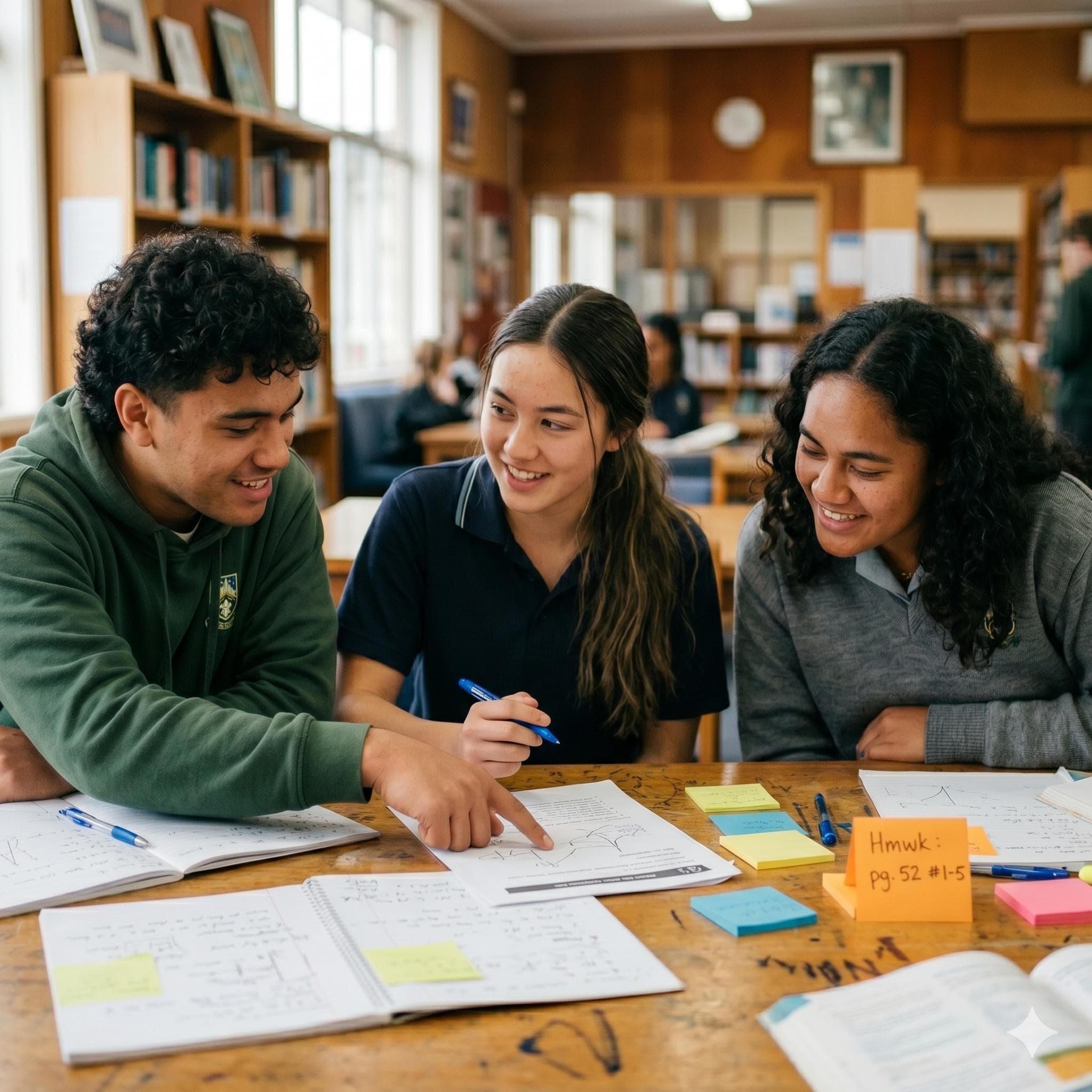
Why this, why now
The AI conversation in Aotearoa is missing the voices it needs most.
Schools are being asked to navigate AI without evidence grounded in their students’ reality. The national strategy focuses on business outcomes. Rangatahi are absent from the table.

No student voice
The AI Forum blueprint and national strategy focus on business outcomes. Young people are not asked what they think, what they want, or what concerns them.

No indigenous perspective
UNESCO and OECD frameworks do not address data sovereignty, tikanga, or the specific experiences of Māori and Pacific learners navigating AI systems built elsewhere.
No NZ-grounded evidence
Schools navigate AI without research that reflects their students’ reality. What works in Ontario or Helsinki may not serve learners in Tāmaki Makaurau or Gisborne.
What YAIRN is
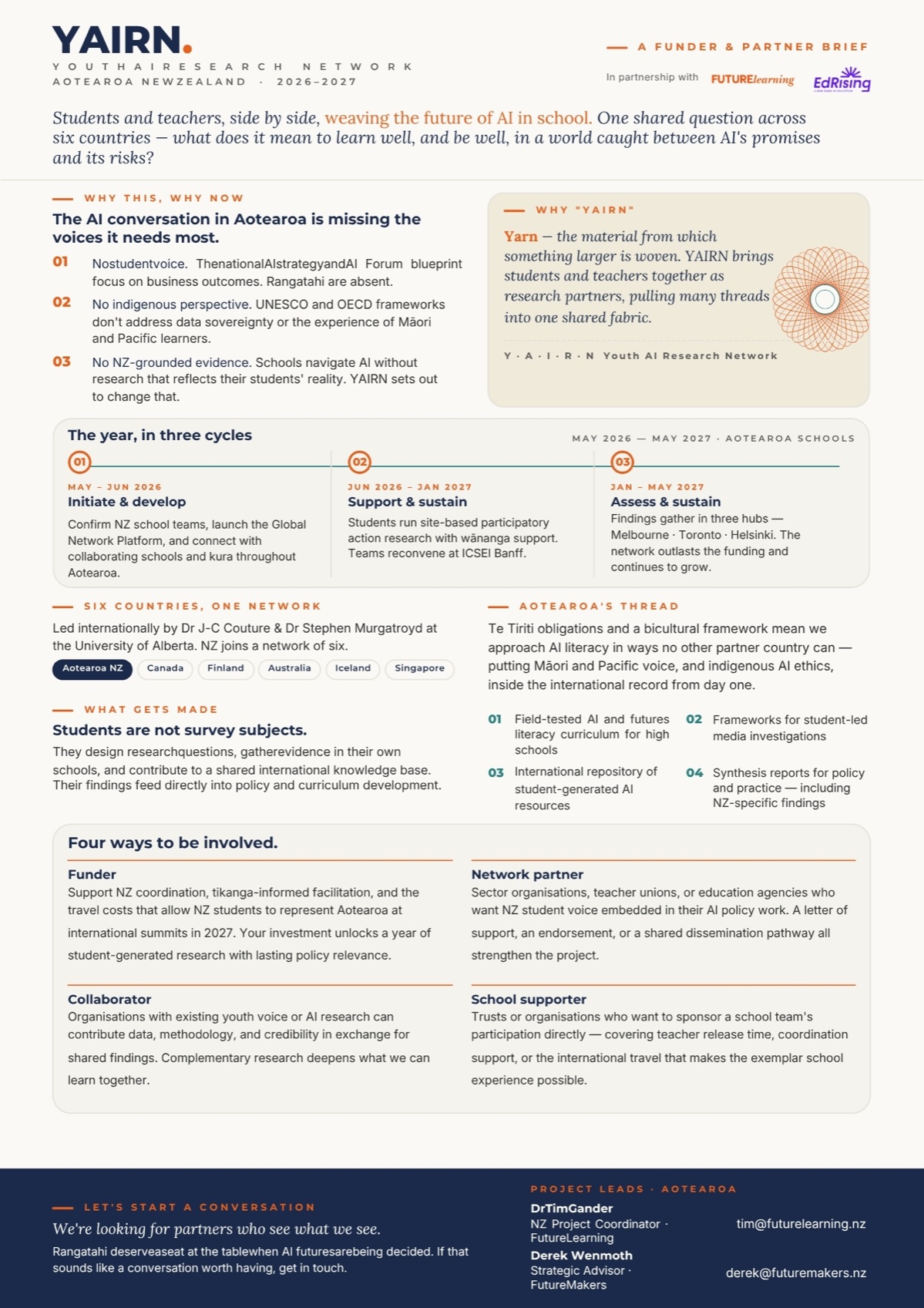
Students and teachers, side by side, as research partners.
YAIRN is an international research network running from May 2026 to May 2027. Led from the University of Alberta by Dr J-C Couture and Dr Stephen Murgatroyd, it connects schools across six countries in a shared inquiry into what AI means for learning and for wellbeing.
In Aotearoa, FutureLearning leads the New Zealand strand alongside FutureMakers, with Tim Gander as NZ Project Coordinator. Our thread is distinct: Te Tiriti obligations and a bicultural framework shape how we approach the research and what we do with the findings.
In YAIRN, students design the research questions, gather evidence in their own schools and communities, and contribute to a shared international knowledge base that feeds directly into policy and curriculum development.
Six countries, one network: Aotearoa NZ · Canada · Finland · Australia · Iceland · Singapore
The international student findings and the Aotearoa-specific findings are produced separately, so NZ schools get both the global picture and the local one.
The research
Two questions. Genuinely open answers.
Every school, teacher, and system tends to start from an assumption that AI is coming and young people need to get ready for it. YAIRN starts somewhere different.
Question one
“To what extent will AI help me learn well?”
Students are free to answer this critically, sceptically, or enthusiastically. The question is not loaded. The evidence they gather shapes the answer.
Question two
“To what extent will AI help me be well?”
Wellbeing, not just learning. Belonging, safety, equity. Young people are the most reliable witnesses to their own experience of school.
A note on our stance. Rangatahi do not need to agree that AI belongs in their future. Scepticism, critique, and refusal are legitimate research positions. YAIRN is not an AI advocacy project. It is a student-led inquiry into a question that has not yet been honestly asked of the people most affected by the answer.
The year, in three cycles
May 2026 – May 2027 · Aotearoa schools
May – June 2026
Initiate and develop
Confirm NZ school teams. Connect with collaborating schools and kura throughout Aotearoa. Launch the Global Network Platform and orient student researchers to the methodology.
June 2026 – January 2027
Support and sustain
Students run site-based participatory action research with wānanga support. Teams reconvene at the ICSEI conference in Banff. Findings begin to take shape across the network.
January – May 2027
Assess and sustain
Findings gather in three international hubs: Melbourne, Toronto, Helsinki. NZ-specific reports are produced. The network is designed to outlast the funding and keep growing.
What gets made
Students are not survey subjects. They are the researchers.
They design research questions, gather evidence in their own schools, and contribute to a shared international knowledge base. Here is what the project produces.
Field-tested AI and futures literacy curriculum
A high school curriculum grounded in what students actually found in their inquiry, not what vendors want them to know.
Frameworks for student-led media investigations
Tools and protocols for young people to critically examine how AI is represented in media and public life.
International repository of student-generated resources
A shared knowledge base, built by students across six countries, publicly available for educators and policymakers.
Synthesis reports for policy and practice
Including NZ-specific findings on Māori and Pacific student experience. Reports ready for Ministry, ERO, and school board use.
“The project addresses a critical gap in current AI education discussions where student perspectives are rarely solicited or considered in decision-making processes.”
Aotearoa’s thread
Te Tiriti obligations and a bicultural framework mean we approach AI literacy in ways no other partner country can.
Putting Māori and Pacific voice, and indigenous AI ethics, inside the international record from day one.
AI systems do not treat cultural identity as a nuance. They tend to flatten distinctions that matter profoundly: the difference between iwi, hapū, and whānau. The difference between being Samoan, Tongan, and Fijian. The difference between one community’s relationship with data and another’s.
The Aotearoa strand of YAIRN is built around OCAP principles: Ownership, Control, Access, and Possession. Student data is the students’. They can contribute to the research and they can remove their contribution. That is not a concession. It is the starting point.
This is why NZ-specific findings are produced separately, not just extracted from the global data. The local findings have their own integrity and their own audience.
Get involved
Four ways to be part of this.
YAIRN is looking for partners who see what we see. Rangatahi deserve a seat at the table when AI futures are being decided.
The full picture, including the year’s three cycles, the international network, and what the project produces, is in the one-page brief.
Option 01
Funder
Support NZ coordination, tikanga-informed facilitation, and the travel costs that allow NZ students to represent Aotearoa at international summits in 2027. Your investment unlocks a year of student-generated research with lasting policy relevance.
Option 02
Network partner
Sector organisations, teacher unions, or education agencies who want NZ student voice embedded in their AI policy work. A letter of support, an endorsement, or a shared dissemination pathway all strengthen the project.

Option 03
Collaborator
Organisations with existing youth voice or AI research can contribute data, methodology, and credibility in exchange for shared findings. Complementary research deepens what we can learn together.

Option 04
School supporter
Trusts or organisations who want to sponsor a school team’s participation directly, covering teacher release time, coordination support, or the international travel that makes the exemplar school experience possible.
Project leads · Aotearoa
The people behind the NZ strand.
Dr Tim Gander
NZ Project Coordinator · FutureLearning
PhD in collaborative synchronous coaching. Fifteen years working in and alongside Aotearoa schools. Peer-reviewed researcher. ERO Expert Group and N4L advisory panel. Founder of AiEdCoP (800+ members). Tim’s work starts from the same question YAIRN does: what actually produces equitable outcomes for learners?
Derek Wenmoth
Strategic Advisor · FutureMakers
Derek’s deep connections across the NZ education system, in New Zealand and internationally, shape the project’s policy reach. Author of Agency by Design, published by the Aurora Institute. Derek and Tim have worked together for years to strengthen the links between international education thinking and Aotearoa practice.
International project leads: Dr Jean-Claude Couture and Dr Stephen Murgatroyd, University of Alberta. Supported by Dr Jean Stiles, researcher and practitioner.
Let’s start a conversation.
We’re looking for partners who see what we see. If that sounds like a conversation worth having, get in touch. The form takes five minutes.
Express interest in YAIRN