Know where your school stands. Know what to do next.
Practical, evidence-grounded support for school leaders navigating AI, from compliance and governance through to sustained practice change.
- Built on NZ legislation and Ministry policy
- Domain-by-domain maturity profile
- Covers practice, governance, and infrastructure
- Board-ready outputs
AI is already in your school. Does your leadership team have a clear picture of how?
In most NZ schools right now
Adoption is outpacing governance
Students and staff are already using AI tools, often without school-wide policy, clear guidance, or oversight in place. In most schools, use is ahead of decision-making.
In force from 1 May 2026
Compliance obligations are live
The Privacy Act 2020 IPP3A requirement for indirect data collection is now in force. Schools that have not reviewed their AI tools against this obligation may already be exposed.
The case for acting now
The opportunity is significant
Schools that get this right, with clear governance, confident staff, and engaged whānau, are better placed for everything that follows. AI can support effective pedagogy, inclusive learning and equitable outcomes.
Most schools have gaps they don’t know about yet.
Students using AI tools they are not permitted to use.
Most mainstream AI tools require users to be 13 or older, with parental consent required under 18. Many schools have no process for checking whether students are using these tools, or for communicating expectations to families.
NZQA authenticity obligations not yet met.
Schools with consent to assess NCEA standards are required to have an authenticity policy that specifically addresses AI. This is a compliance requirement, not optional guidance. Many schools have a general authenticity policy that has not been updated.
Privacy Act exposure from AI use in administration.
School admin staff routinely use AI tools to draft communications, process enquiries, and prepare documents. Where this involves personal information about students or families, Privacy Act obligations apply. In most schools this use is ungoverned.
The IPP3A indirect collection requirement.
From 1 May 2026, schools are required to notify individuals when personal information about them is collected indirectly, for example, through AI tools that process information about students or whānau who have not directly interacted with the tool. This is a real and specific obligation, but it sits within a broader compliance picture that has been in place since 2023.
Staff using AI tools with student information without privacy checks.
Teachers using AI to generate feedback, reports, or assessments may be entering student information into tools whose data handling terms have never been reviewed. Most schools have no register of which tools are in use or how each one handles data.
No board-level visibility of AI use or risk.
Boards are responsible for the governance of their school. In most schools, the board has not received structured information about how AI is being used, what risks this creates, or what the school’s current position is.
Te Ara Tūāpae
A framework built for Aotearoa schools
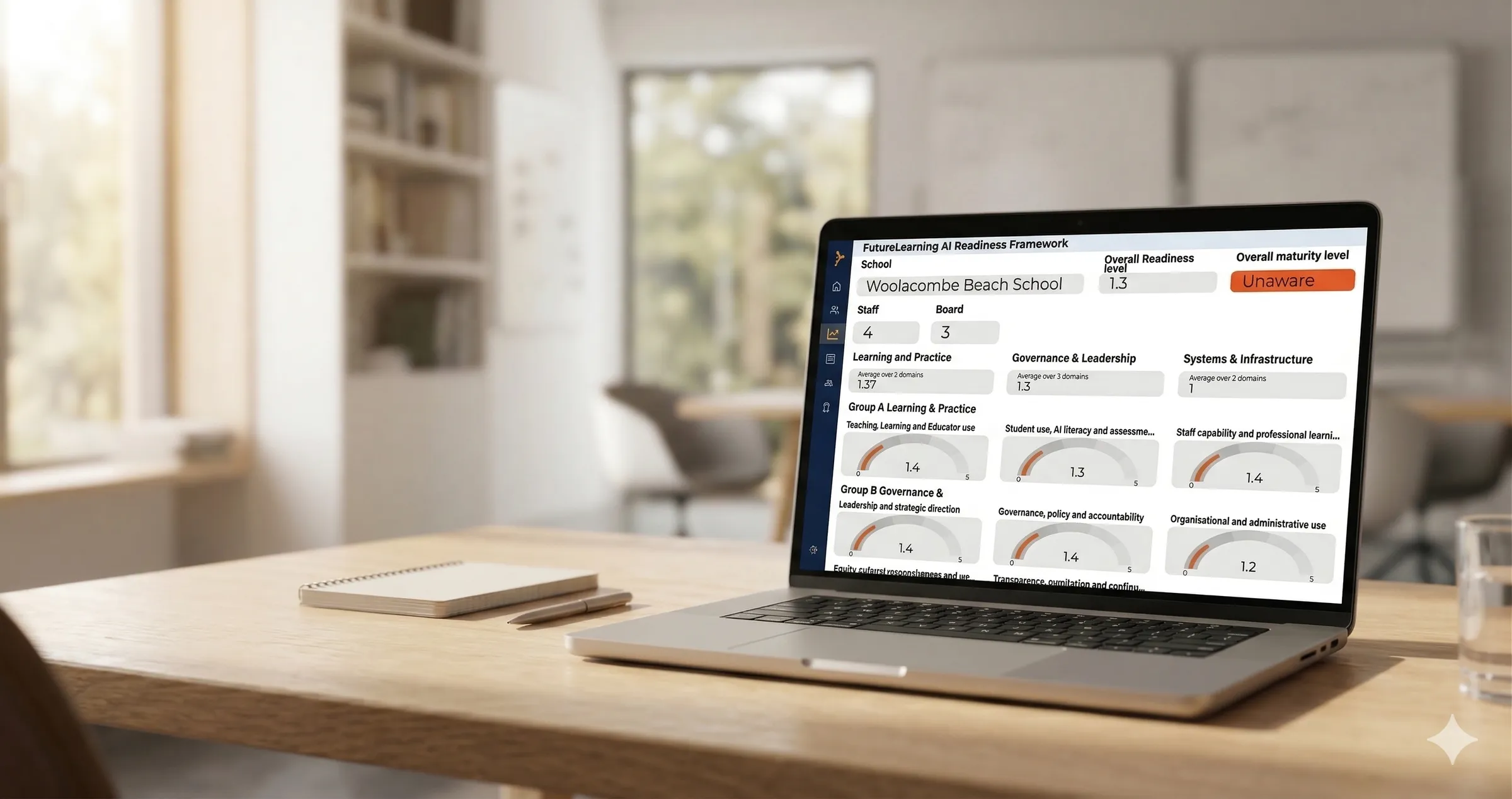
Te Ara Tūāpae, the pathway to the horizon, is a structured diagnostic assessment of how your school is using, governing, and preparing for AI across all operational domains. Not just teaching and learning.
It sits above the infrastructure layer. ST4S and the Ministry cyber assessment tell you about products and network security. Te Ara Tūāpae tells you about practice, governance, and culture. They do not overlap.

Ten domains, three groups
Group A · Domains 1 to 3
Learning and Practice
How AI is shaping teaching and learning, student use and assessment integrity, and staff capability.
Group B · Domains 4 to 8
Governance and Leadership
How your leaders and board are setting direction, managing risk, building policy, strengthening oversight, and ensuring equity and cultural responsiveness.
Group C · Domains 9 to 10
Systems and Infrastructure
How privacy, procurement, security, and information governance support safe and sustainable AI use. Referenced against ST4S and the Ministry cyber assessment, not duplicated.
Ten domains. Five maturity levels. Each assessed independently.
Not a survey. Not a snapshot. A governance tool your school owns.
The AI Readiness and Practice Review produces something your school can act on immediately and return to over time. Three respondent groups, principal, staff, and board, complete the assessment independently. Results are disaggregated so you can see where perspectives align and where they do not.
The result is something your school actually owns. Not a consultant’s report that sits in a drawer. A living dashboard your leadership team can return to, share with the board, and use to track progress year on year.
The review draws on operational budget and is approved at principal and board level. It is a governance and compliance tool, not a professional development option. Most principals approve this at their own level without a separate PLD application.
Interactive analytics dashboard
Your school’s individual login. Domain-by-domain maturity scores across all ten domains, with specific next steps for each. Updated at each review cycle.
Compliance flags
Explicit identification of any Privacy Act exposure your school carries, including privacy impact assessment gaps, technology register status, vendor due diligence, and IPP3A notification obligations. Plain language. Actionable.
Prioritised action plan
A staged, realistic pathway specific to your school’s results. What to address first, and why. Not a generic checklist.
BOT-ready governance summary
A plain-language narrative ready to share with your Board of Trustees, covering risk, compliance, and recommended next steps.
Results Briefing (optional add-on)
A 90-minute online session with Tim to work through findings, prioritise actions, and answer leadership team questions.
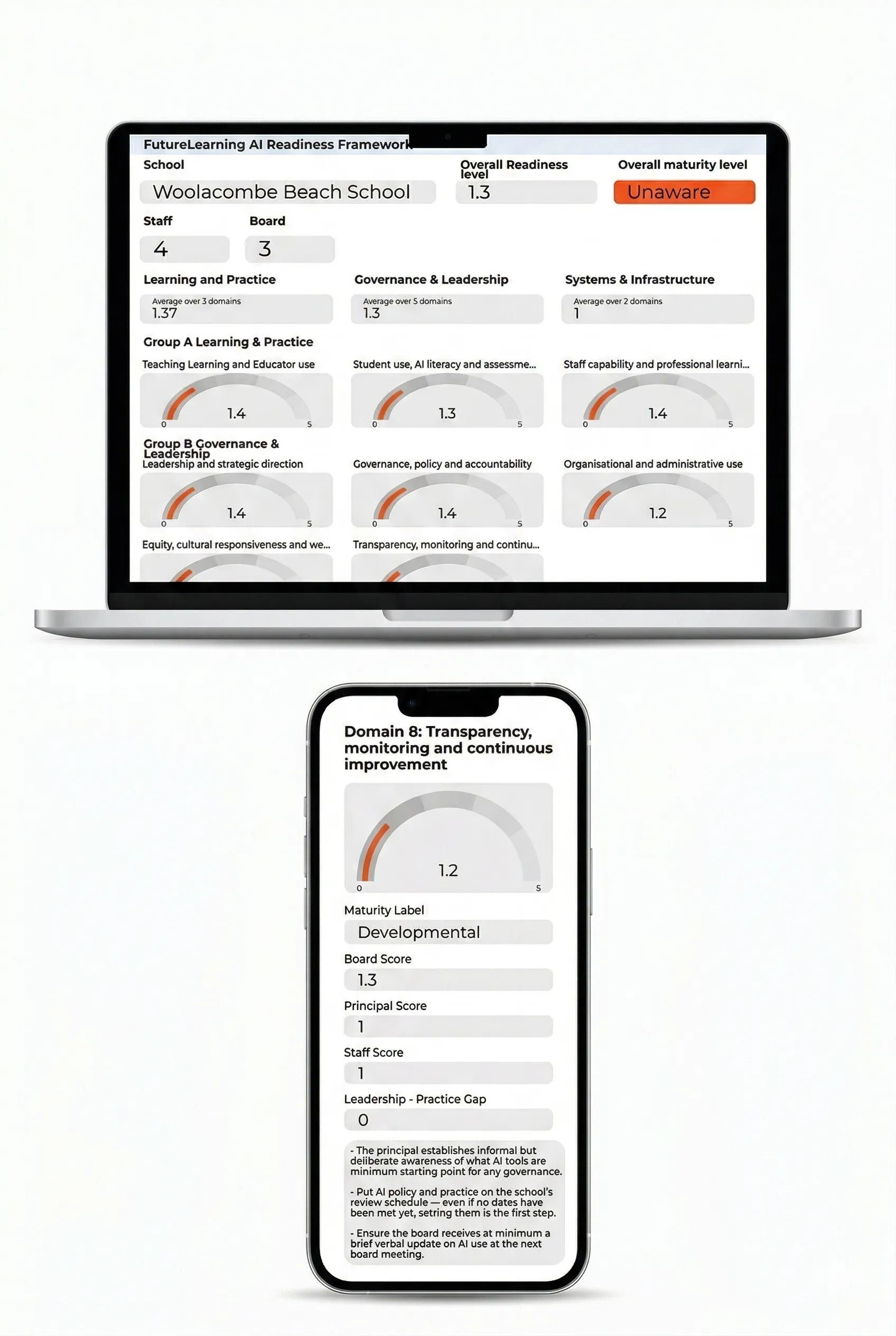
Where does your school sit on each domain?
Each domain is rated independently. Most schools find they are strong in some areas and underdeveloped in others. That is exactly the insight the review is designed to surface.
Unaware
No formal consideration of AI in this area. The school is unaware of obligations, risks, or opportunities in this domain.
Starting pointEmerging
Some awareness and initial steps taken, but practice is inconsistent or limited to a few individuals.
Common starting pointDeveloping
A more structured approach is in place. Policies or practices exist but are not yet embedded or consistently applied.
Many NZ schoolsEmbedding
Consistent, school-wide practice. Policies are understood and applied. The school can demonstrate this domain is well managed.
Target: year oneLeading
Innovative and reflective. The school actively reviews and improves practice and contributes learning to the wider sector.
AspirationalBuilt to improve over time, not just measure once.
The review is designed as an annual cycle. Your first review establishes a baseline across all ten domains. Your second review activates Change and Direction tracking, showing exactly where your school has moved and by how much.
Schools that return for a second review consistently report that the year-on-year comparison is the most valuable output. It makes improvement visible, gives the board evidence of progress, and surfaces where focus is needed next.
The review instrument is updated annually to reflect changes in NZ legislation, Ministry guidance, and international evidence. Your dashboard always reflects the current standard, not last year’s.
What happens after?
The review is the starting point. What comes next depends on what it shows. Some schools act on their findings independently. Others want structured support to build on what the review surfaces. FutureLearning offers three pathways that follow from the review.
Practice Partnerships
Year-long collaborative professional learning for educators, RTLB clusters, schools, and leaders. Built around ongoing mentoring and shared practice, not one-off events.
- Eight 90-minute sessions across the year plus a capstone hui
- Peer clinics, case-based discussion, and structured reflection
- Shared resource hub of prompts, workflows, and templates
- Cultural and ethical grounding woven through every session
Advisory and Ongoing Support
Flexible strategic support shaped by what your school actually needs after the review. Not a packaged programme.
- Strategic advisory for leaders and boards on AI governance and policy
- Bespoke facilitation for planning days and board briefings
- Post-audit retainer for ongoing access to specialist advice
- Available as a day rate, retainer, or defined project
Parent and Whānau Support
Practical support helping families navigate AI alongside their young people. Two strands, both designed for institutional access rather than direct parent-pay.
- Parent AI Course for families supporting young people with AI
- Consultation Continuity model for families of neurodiverse learners
- Initiated when the review identifies gaps in family engagement
- Equity sits at the centre of the model
Ready to know where your school actually stands?
The review takes approximately 15 to 25 minutes for each respondent group. Results are ready immediately. The conversation to get started takes about 5 minutes.
Fill in the short expression of interest form
This gives Tim the basic context about your school and confirms your interest. Takes about five minutes.
Receive your school’s individual dashboard login
Once confirmed, your school gets its own login to the FutureLearning AI Readiness dashboard, ready for your respondent groups.
Principal, staff, and board complete the review
Each group works through their section independently. Results are disaggregated so you can see where perspectives align and where they differ.
Ready to find out where your school stands?
A conversation costs nothing. In 30 minutes, Tim can answer your questions, walk you through what the review covers, and help you decide whether it’s the right fit for your school right now.
Book a conversation